

An Inflection Point: What Mission-Led Leaders Need to Recognize Early
There’s a word that shows up often in strategy conversations: inflection point.
In business, it usually refers to a meaningful shift in a company’s trajectory, a moment when growth, demand, margins, or market conditions begin to move in ways that can alter what comes next. The problem is that once the term moves into broader leadership conversations, it often gets used loosely. The urgency stays. The precision doesn’t.
After 25 years working across sectors, with purpose-driven SMEs, social enterprises, associations, nonprofits in transition, and mission-led organizations of many different kinds, I’ve come to see an inflection point as something more specific. It is a consequential period when early signs begin to show that the path you’ve been on is no longer enough, and the decisions you make next will shape what comes after. I’ve seen this pattern play out across enough contexts to know that the signs usually show up before leaders have language for them.
What matters is recognizing that moment early enough to respond with clarity, before the cost of drift compounds.
If you’re leading a mission-driven enterprise, there’s a good chance you’re either at one right now or approaching one sooner than you think.
Why This Moment Demands a Different Response
Inflection points are not rare events. They are structural realities for any organization that survives long enough to grow, shift, or confront external pressure. What’s equally true, and less often acted on, is that they are not one-time experiences. Every stage of growth carries the potential for a new one. Market conditions shift. Stakeholder expectations evolve. Technology changes the rules. The natural maturation of your programs, products, and services creates new demands on systems that weren’t built for them. The pressure to move on AI alone is accelerating this cycle significantly, compressing timelines that organizations used to have years to navigate into months.
Size doesn’t exempt you from this. Neither does past success. And the speed at which these shifts are now compounding means the window between sensing something is off and being forced to react is getting shorter.
What makes inflection points genuinely dangerous, though, is not their pace. It’s the pattern of response they tend to produce. Most leaders feel one before they can name it. The discomfort is real, but when the source isn’t immediately clear, two things tend to happen: organizations drift, or leaders zero in on the most visible symptom and solve for that alone, mistaking the signal for the cause.
Research consistently shows that leaders often misread recurring organizational problems as isolated performance issues, when the deeper cause is structural, unclear priorities, poor governance, siloed decision-making, misaligned incentives, or weak information flow. Harvard Business Review has written directly about this pattern, arguing that many recurring performance problems are symptoms of organizational design rather than individual failure. McKinsey’s State of Organizations research reinforces the same point at scale: in a survey of more than 2,500 leaders, two-thirds described their organizations as overly complex and inefficient, and only half felt prepared to anticipate and respond to external shocks. Across sectors and sizes, the pattern is familiar. Most organizations are not struggling because people are not working hard. They are struggling because the problem being solved is not the one actually driving the friction.
That’s the risk at an inflection point. The problem usually isn’t inaction. Most leaders are already moving. The risk is moving in the wrong direction.
What an Inflection Point Actually Is
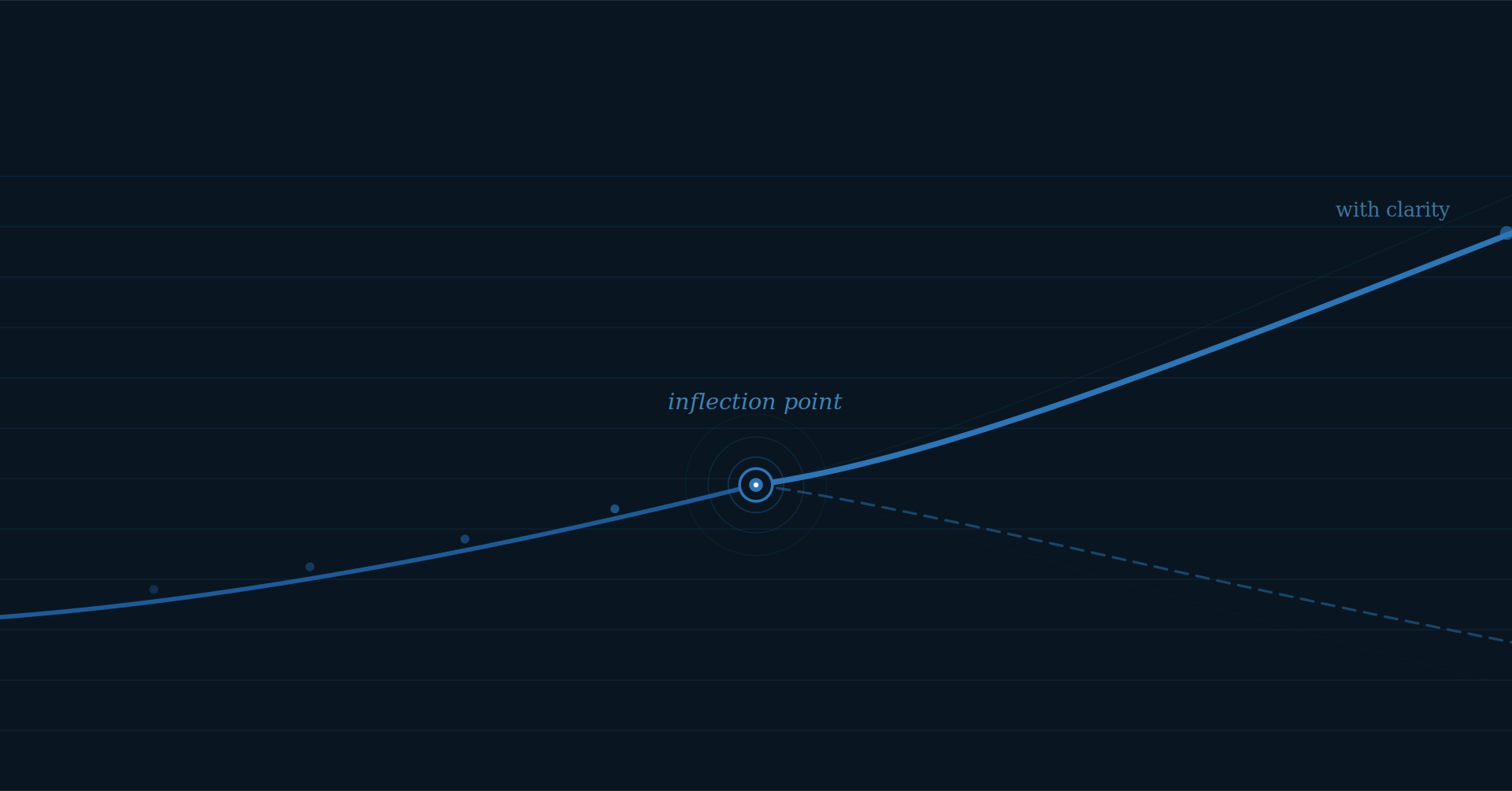
In mathematics, an inflection point is where a curve changes concavity, the direction of its bend. In business and strategy, the term is borrowed to describe a point where conditions shift enough that the current model, strategy, or operating system may no longer be sufficient.
In an organization, that plays out as the place where the systems, structures, and strategies that got you here stop being adequate for where you need to go.
Crucially, it is not a single problem. It is a convergence. A revenue model that no longer scales. A governance structure that can’t hold the weight of growth. A team stretched beyond its capacity to perform. Programs, projects, or products that have outgrown the infrastructure supporting them. A mission that has evolved faster than the organization’s ability to execute it. AI, policy shifts, and changing funder or customer expectations are reshaping the rules.
When several of those pressures converge, that’s typically when an inflection point becomes visible.
The trap most leaders fall into is solving for one of them while the others continue to accelerate. A new revenue strategy without operational alignment. A strategic plan without governance readiness. A team restructure without clear priorities. Each fix creates the illusion of progress without addressing the root system.
That’s why inflection points require a different kind of thinking. It needs more precision rather than more effort.
The Four Lenses: How an Inflection Point Lands Differently Across Your World
Inflection points are difficult to navigate because they look different depending on where you sit. The same organizational moment reads completely differently in the boardroom, in the team, in the mission, and in the stakeholder relationship. Here’s what it looks like through each lens.
For the Organization
Structurally, an inflection point shows up as misalignment between your capacity and your commitments. For a purpose-driven SME, that might look like strong market demand that your operations can’t fulfill at margin. For a social enterprise, it might be an earned revenue model that’s growing but hasn’t been designed to scale. For a nonprofit in transition, it could be the moment grant dependency finally collides with the need for a more resilient business model.
Across all of these, the pattern is the same. Revenue is plateauing, unpredictable, or being outpaced by costs. The systems built for your current size can’t handle what’s next. The organization starts operating reactively. Decisions get made based on what’s urgent rather than what’s important. The gap between what you say you do and what you’re actually resourced to deliver quietly widens.
For the Mission
For mission-led enterprises, this is where the real cost lives.
An organization at an inflection point that doesn’t course-correct doesn’t just underperform financially. It underdelivers on its reason for existing. Products don’t reach the communities they were built for. Programs get cut or compromised. Projects stall mid-execution. Services erode in quality because the team is stretched past capacity. The communities, customers, and people you serve feel it first, often before the board does.
Mission drift is a slow bleed. It happens when financial pressure forces decisions that compromise purpose. When leadership is too consumed with operational fires to stay anchored to strategic intent. When the mission statement stays on the wall while the reality of the work moves further away from it.
An inflection point addressed well is also an opportunity to reorient back to core purpose with fresh clarity and a stronger foundation to execute from.
For Employees and Leadership
Teams feel inflection points before they can articulate them in a meeting.
It shows up as fatigue that rest doesn’t fix. As ambiguity about priorities that more effort can’t resolve. As talented people quietly disengaging or leaving. As leaders who are individually capable but operating in silos, solving in parallel rather than together. As founders carrying decisions that should be distributed, because the systems to support distribution don’t yet exist.
The Canadian Mental Health Association’s study Going it Alone: The Mental Health and Well-Being of Entrepreneurs in Canada found that 62% of Canadian business owners reported battling depressive episodes at least once a week, and nearly half said mental health issues actively interfered with their ability to work. Burnout and chronic strain remain among the clearest signals that an organization is carrying more ambiguity, pressure, and structural friction than its systems can absorb.
This matters for one reason that gets missed in most leadership conversations: burnout is not a personal resilience problem. It is a systems problem. When organizational priorities aren’t clear, everyone fills the gap by working harder. When strategy isn’t sequenced, effort multiplies without proportional results. When communication runs reactive rather than intentional, trust erodes faster than anyone tracks.
At an inflection point, your people are watching what leadership does. The decisions you make or don’t make signal what the organization actually values. Culture is what you demonstrate under pressure, not just what you declare.
For Stakeholders, Partners, Investors, Funders, and Boards
Stakeholders experience inflection points differently depending on their relationship to the organization, but the underlying signal is the same: confidence begins to waver.
For the board of a social enterprise or purpose-driven SME, it often surfaces as governance strain: boards are asked to approve decisions without adequate information, oversight functions begin to blur into operations, or board composition no longer reflects the organization’s strategic complexity.
For funders and impact investors, it surfaces as uncertainty. Reporting that tells a story of activity without clarity on outcomes. Relationships sustained by personal credibility rather than demonstrated results. Proposals that describe what you’ve always done, rather than a compelling vision of what’s now possible.
For corporate partners, ecosystem allies, and community stakeholders, it shows up as a subtle but widening gap between what your organization promises and what it delivers. They don’t always tell you when their confidence is wavering. They redirect their attention. And their resources follow.
The risk across all three groups is the same: stakeholder confidence erodes faster than most leaders realize, and rebuilding it costs significantly more than maintaining it would have.
Where They Converge
Here’s what’s true across all four lenses: when an organization is at an inflection point, every domain feels it simultaneously.
How to Know You’re There: The Symptoms
Inflection points rarely announce themselves cleanly. But they leave a distinct trail. These signals apply whether you’re running a social enterprise, a purpose-driven product or service business, or a nonprofit moving toward earned revenue. If you recognize four or more of the following, you’re likely in one.
Strategic signals:
- Your strategic plan exists, but real conversations about execution tend to happen informally, in side conversations and one-on-ones rather than in structured planning sessions
- Your revenue model requires more effort each cycle to produce the same result
- You’re saying yes to opportunities based on need rather than alignment with where you’re going
- You can articulate your value proposition, but your path to sustaining it is unclear
Operational signals:
- The same problems keep resurfacing despite repeated attempts to resolve them
- Decision-making has become concentrated and is creating a bottleneck to progress
- You’re running on institutional knowledge rather than documented, transferable systems
- Programs, projects, or products are scaling in demand but not in capacity
- Execution speed has slowed and the reasons aren’t immediately visible
People signals:
- Your best people are carrying more than they should, and some have stopped raising problems
- Onboarding takes longer than it should because role clarity and priorities aren’t well-documented
- Leadership meetings generate discussion, but not always clear decisions.
- There’s a cultural tension in the room that hasn’t been named directly yet
External and market signals:
- Customer, funder, or investor expectations are shifting and your current model doesn’t fully meet them
- Peers and competitors in your space are moving with more confidence and speed
- AI may be changing your workflow, your market, or your delivery context in ways that don’t yet have a clear organizational response
- Small business confidence across Canada fell to the lowest level recorded in CFIB’s Business Barometer in March 2025, driven by rising costs, weak demand, and trade-related uncertainty. If you’re navigating those conditions on top of internal strain, that convergence is worth taking seriously.
- Governance practices feel like friction rather than support
None of these alone constitutes an inflection point. Together, they form a pattern that deserves direct attention.
The 80/20 of What to Move First
This is where most strategic conversations go sideways. Leaders at inflection points often attempt to fix everything at once, which means nothing gets the depth of attention it needs.
The 80/20 principle at an inflection point is not about doing less. It’s about sequencing correctly.
Start with clarity before strategy. You cannot build a meaningful plan on a misdiagnosis. Before deciding what to do, invest in understanding what’s actually driving the friction, beyond the immediate symptom and down to the root cause. Is the revenue problem a positioning problem, a model problem, or a capacity problem? Is the team friction a culture problem or a clarity problem? The answer determines the solution entirely.
Stabilize the core before scaling anything. If your operational foundation is fragile, scaling will amplify the fragility. The instinct to grow through the pressure often accelerates the problem. Stabilize first.
Align leadership before aligning systems. The most sophisticated operational redesign will fail if the leadership team doesn’t share a coherent picture of priorities and direction. Start there.
Address governance before it becomes a crisis. Governance issues are slow-moving and easy to defer. They are also among the most expensive to fix after the fact. Getting ahead of them is almost always possible and almost always underestimated.
Then, and only then, build for what’s next. Revenue diversification. New product or program lines. Technology and AI integration. Market expansion. These are leverage points that compound on a stable foundation. Attempted on a weak one, they drain the organization further.
The practical test: if you could only move three things in the next 90 days, what would they be? If that question takes more than a moment to answer, that’s your starting point. Clarity itself.
The Cost of Not Acting
This is worth stating plainly.
The cost of staying at an inflection point without responding is not zero. It is not a neutral holding pattern. Every quarter of misalignment has a measurable price: in lost or leaking revenue, in staff capacity that drains rather than compounds, in stakeholder confidence that quietly erodes, in products and programs and services that don’t reach their full potential.
The cost of drift is measurable. McKinsey has long reported that roughly 70% of transformation efforts fail to meet their objectives, and Bain’s 2024 analysis suggested the share falling short of original ambitions may be even higher, at 88%. McKinsey’s more recent strategy research also found that only 21% of executives believe their strategies meet a meaningful standard of rigor, a sharp decline from earlier years. And while pressure to respond to AI is accelerating this cycle significantly, Statistics Canada reported that 12.2% of Canadian businesses had used AI to produce goods or deliver services over the previous 12 months in the second quarter of 2025, up from 6.1% a year earlier. Every quarter of delayed clarity compounds the cost, operationally, financially, and strategically.
The organizations I’ve seen navigate inflection points well share one characteristic: they acted before it became a crisis. Not because they had certainty, but because they had clarity on what mattered most, and the discipline to focus there.
The ones who waited share a different characteristic: they spent more time, more money, and more goodwill fixing what could have been adjusted.
What Happens When You Act
When a mission-led organization addresses its inflection point with the right kind of thinking, the change is tangible and it moves faster than most leaders expect.
Revenue models get redesigned to be less fragile and more diversified. Leadership teams operate with a shared map, making faster, better decisions with less friction. Boards move from oversight anxiety to genuine strategic partnership. Teams exhausted by ambiguity become energized by clarity. Products, programs, and services get the infrastructure they need to scale. Impact becomes measurable, communicable, and fundable.
The mission, the reason all of it exists, gets stronger. Not because the pressure disappeared, but because the organization built the capacity to meet it.
That’s what I mean by Clarity. Focus. Results.
It’s not a tagline. It’s a sequence. Clarity enables focus. Focus enables results. In that order, every time.
This Is the Work We Do Together
At Social Mission Canada, I work with mission-led leaders at exactly this moment. As a peer and partner, I work inside your reality, with your team and in your context, to surface what is actually driving the friction and design solutions that last beyond the engagement.
Our work spans strategy through execution and covers the full system: financial resilience and revenue model design, governance and board readiness, operational systems and leadership alignment, and technology and AI readiness. We work across purpose-driven SMEs, social enterprises, and nonprofits in transition because inflection points don’t respect organizational type, and neither does our approach.
If this sounds familiar, something structural is probably asking for attention and that’s often where the most productive work starts. If you’re ready, let’s talk.


